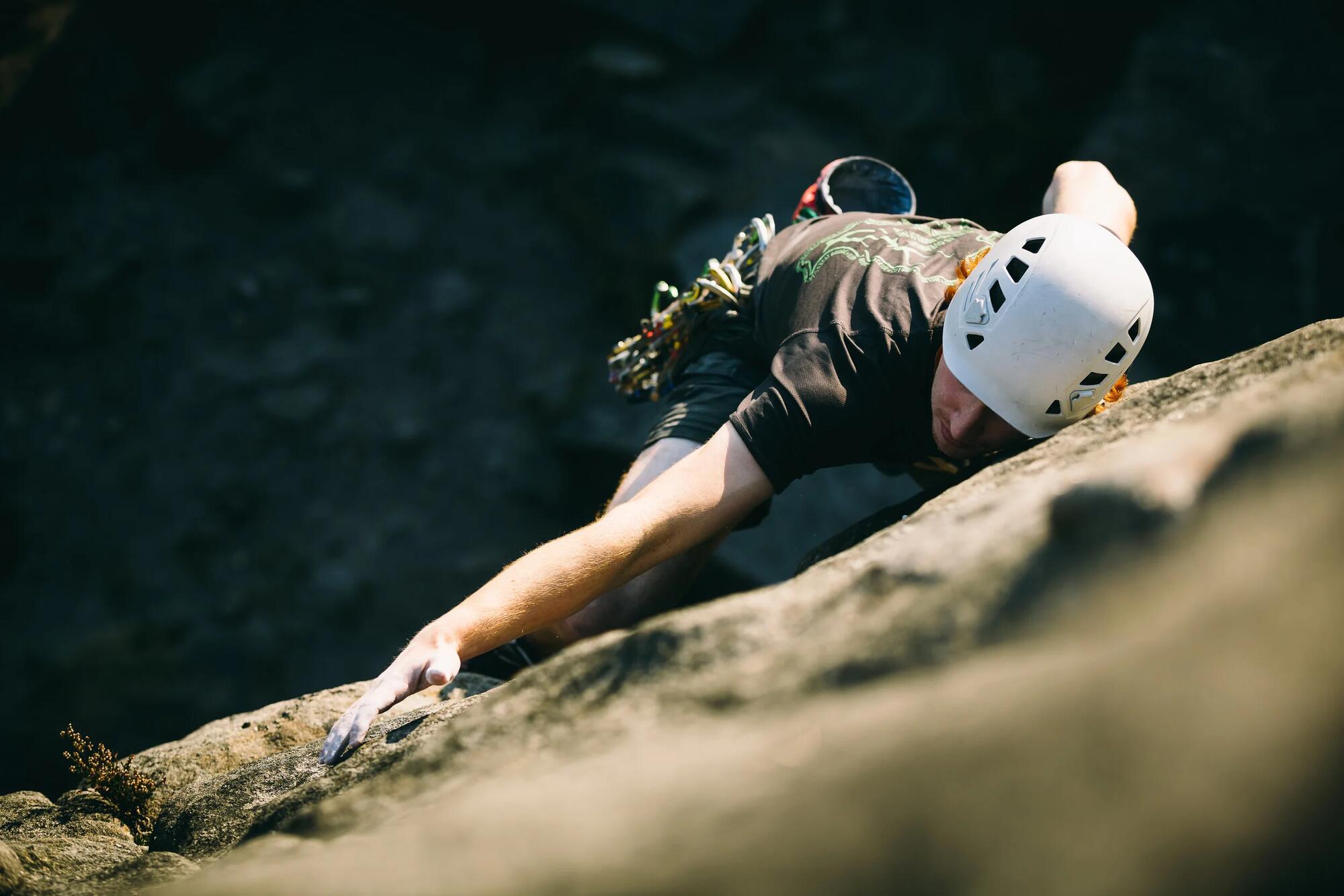
You haven't started climbing yet, but your body is already responding. Your heart is quicker. Your stomach feels unsettled. You keep imagining the move that might go wrong.
Nothing has happened. And yet, to your nervous system, something important is already happening: there is a situation ahead that may demand more than you feel ready to give.
Understanding that response changes the question. Instead of asking, "How do I stop being anxious?", you can begin asking, "What is happening, and what would help me respond?"
1An alarm system, not a character flaw
Anxiety is a normal human experience. When we anticipate danger or difficulty, the body can prepare for action and the mind can start searching for problems. Physical changes may include a more noticeable heartbeat, sweating, tension or an unsettled stomach. Worry and difficulty concentrating can arrive alongside them.
Sometimes this is useful. Concern about a remote trip might prompt you to check equipment, practise navigation, or discuss an emergency plan.
But an alarm responds to perceived threat. It doesn't provide a perfect measurement of actual danger.
A difficult move, an audience, a past mistake, or uncertainty about what comes next can all become part of the picture. Feeling anxious does not, by itself, tell you that the situation is unsafe. Equally, feeling calm does not prove that it is safe.
2Notice thoughts, body and behaviour
It helps to look at anxiety through three connected areas.
Thoughts: "I'll fall." "Everyone will notice." "I won't cope." Your mind may jump ahead, replay previous experiences, or search for certainty.
Body: You may notice tension, quicker breathing, shaking or discomfort. The sensations themselves can become another source of worry.
Behaviour: You might avoid the route, delay starting, repeatedly seek reassurance, or rush to get the experience over with.
For a climber, a thought about falling might be followed by gripping harder and holding the breath. Fatigue then builds, making the original worry feel more convincing.
These parts influence one another. That also means there is more than one place to make a change. You don't have to win an argument with every anxious thought before doing something helpful.
1 · Situation
The route above
Something ahead that matters and might not go well.
2 · Thought
“I’ll fall here”
The meaning you give it — usually faster than words.
3 · Body
Tight, quick, braced
Heart rate up, grip harder, breathing shallow.
4 · Behaviour
Take, or back off
The move that makes the feeling stop, right now.
And round again. The relief is real, which is exactly the problem — it teaches the thought it was right, so next time it arrives sooner.
3Separate useful preparation from a worry loop
Useful preparation produces an action. "I'm uncertain about the route" might lead to gathering appropriate information or asking a qualified person for guidance.
A worry loop returns to the same question without producing anything new. You check again, imagine another possibility, and still don't feel sufficiently certain.
One useful distinction is: "Is there a practical step I need to take, or am I trying to guarantee that nothing difficult will happen?"
Take the practical step when one is needed. Where uncertainty cannot be removed, practise meeting it in manageable, appropriately supported ways. In sport, perceived demands and coping resources can be part of anxiety, but they aren't its only causes. Anxiety is not simply a shortage of skill.
4Respond without fighting yourself
Begin by naming what you notice: "I'm having the thought that I won't cope. My shoulders are tense. I'm delaying the start."
Where it is safe to pause, allow comfortable, unforced breathing and orient to your surroundings. Then identify the next useful action: ask a question, adjust the plan, or return attention to the task.
Avoidance can sometimes maintain fear, but stepping back from genuine danger is sensible. Psychological practice should never replace technical competence, risk assessment or appropriate supervision.
Seek support when anxiety persistently affects sleep, relationships, work, enjoyment or participation. A GP or qualified mental-health professional can help you understand what is happening. New or concerning physical symptoms should not automatically be assumed to be anxiety.
The aim is not to become a person without an alarm system. It is to understand it well enough that it doesn't make every decision for you.