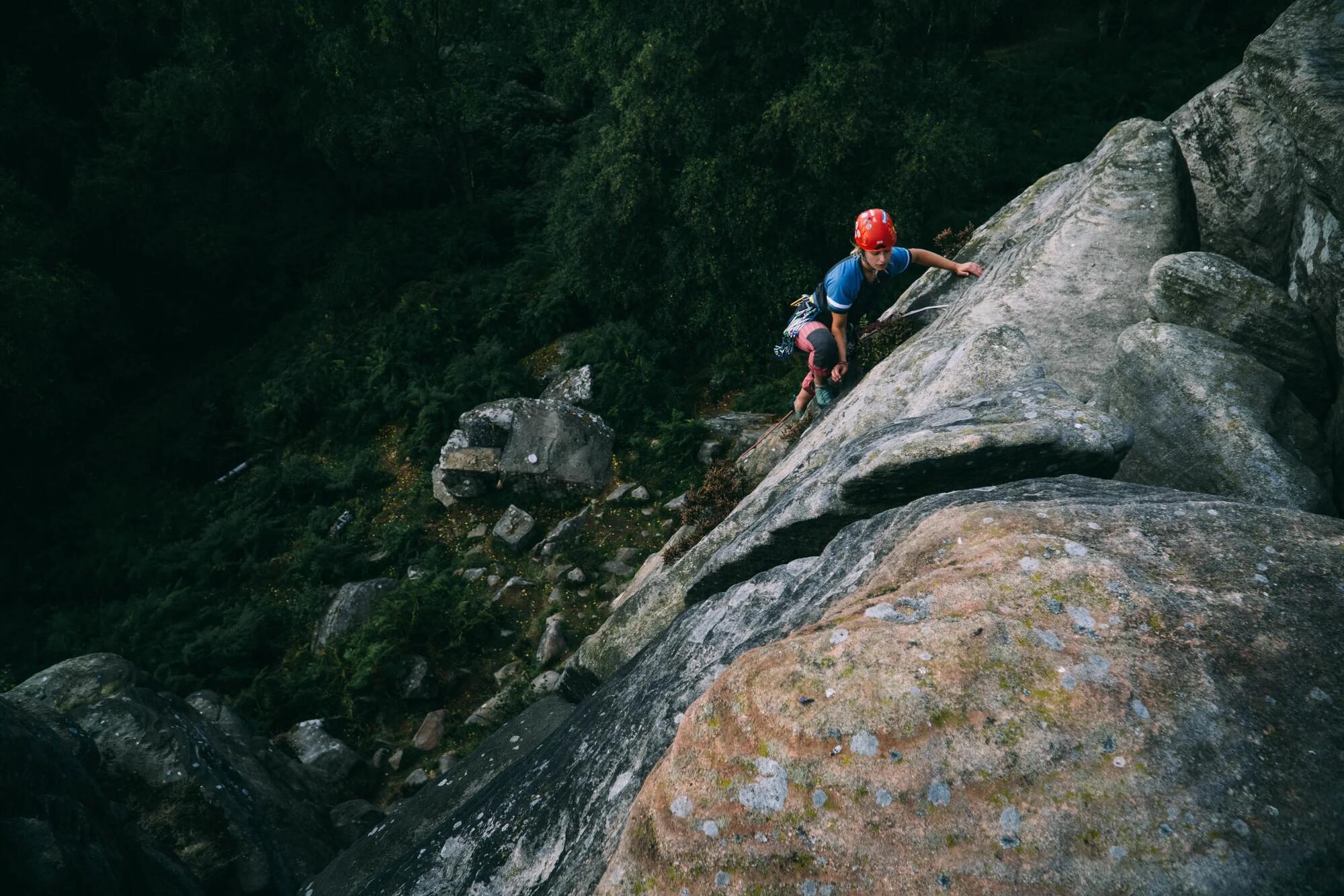
You look up at a route. The moves appear to be within your ability, but the protection is spaced, and a fall from the wrong place could have serious consequences.
“Trust yourself” doesn’t quite answer the question in front of you. Neither does “just practise falling”.
Not all fear is something to overcome. When the consequences are real, caution can be appropriate. The British Mountaineering Council makes this distinction in its guidance on exposure to heights: feeling apprehensive around a potentially serious drop is not, in itself, irrational.
The question becomes: how do I make a sound decision about this situation, and manage myself effectively within that decision?
Two things sit at the heart of this: a clear decision-making framework, and a gradually developed base of experience.
1Before you leave the ground
The framework has three steps: assess the risk, decide whether you are willing to accept the consequences, and plan your response. These are separate questions. Being capable of climbing something doesn’t automatically mean you want to accept its risks. Being willing to accept a risk doesn’t automatically mean you are prepared for it.
Step 01
Assess the risk
What are the real consequences on this route?
Step 02
Am I willing to accept them?
No
Back off, or change the plan.
Yes
Continue to step three.
Step 03
Plan your response
Know what steadies you — breathing, imagery, a cue — before you need it.
“Can I act on the situation, prepare my response, or do both?”
1. Assess the risk
Start with the question from the framework: what are the real consequences on this route?
Look beyond how intimidating the climbing feels. Consider what could happen, how likely it appears, and what remains uncertain. What is the protection like? Are there ledges or awkward landings? How do the conditions, your current ability and your fatigue affect the situation? Mountain Training’s guidance similarly emphasises protection, route choice, conditions and the climber’s readiness when judging whether climbing can proceed appropriately.
The aim is neither to exaggerate the danger nor to explain it away. It is to make the clearest assessment you can.
Where you lack the knowledge to assess something important, seek appropriate instruction or guidance. Missing safety information is not a confidence problem.
2. Am I willing to accept the consequences?
Once you understand the situation as well as you reasonably can, ask whether you are willing to accept the remaining risk.
This is not a test of courage. Try asking: would I still choose this without an audience, a grade to prove, or someone encouraging me to carry on?
In the framework, no means back off or change the plan; yes means continue to the planning stage. Neither answer needs to become a judgement about who you are as a climber.
A decision not to climb can be a successful outcome. So can choosing a better-protected alternative, returning with more experience, or deciding that a particular kind of risk simply isn’t something you want from climbing.
3. Plan your response
The final step is knowing, before you leave the ground, what will steady you when the nerves arrive.
Under pressure you do not invent a technique. You reach for whatever you have already practised, which is why this step is less about resolve than about having two or three things you know work for you.
Breathing. A few cycles with the out-breath longer than the in-breath will slow the physical escalation enough to let you think. Use it at a rest, or on the ground before you pull on — not as something you try to remember for the first time halfway through a move.
Imagery. Rehearse the sequence beforehand, including the section that worries you, and including what you do if it does not go to plan. Climbing it in your head first means your body is not meeting it cold. More on imagery and visualisation.
Self-talk. Choose a short cue in advance — “place the foot”, “steady”, “breathe, then move”. Instructional cues tend to work better than encouragement when you are trying to execute, because they tell you what to do rather than how to feel. More on self-talk.
The tactical planning sits alongside it and works the same way. Where could you pause securely? What will you do if the climbing is different from what you expected? What do you need to agree with your partner before you set off? What options would you have if continuing no longer felt appropriate?
None of this removes the fear, and it is not meant to. The point is to keep enough of yourself available to act — so that once you have decided a move is within you, you can commit to it rather than stall halfway and make the situation worse.
Planning does not commit you to continuing regardless. Treat the decision as something you can revisit when new information appears — not a promise you made on the ground.
2Build a pyramid of experience
The second part of the approach is gradual experience. The pyramid moves from climbing well within your grade, through committing but known, and bigger runouts, towards your limit. Its central distinction is important: you are not exposing yourself to falling here. You are building experience of climbing, and of managing yourself, in increasingly demanding situations.
The broad base matters most. Spend time on climbing that leaves room to notice, make decisions and practise your approach — not just survive the next move.
“Committing but known” introduces a different question: can you apply what you have learnt when the situation requires more commitment, but the climbing is familiar? Greater uncertainty or commitment should come only after reassessing the particular risks, not because you have completed an arbitrary number of easier routes.
This is not an instruction to keep increasing runouts or climbing higher. The top of the pyramid is not a destination everyone needs to reach. Nor should “at your limit” be read as encouragement to practise emotional regulation where a small mistake could be catastrophic.
Use the pyramid as a reminder to build a substantial foundation beneath the challenges you choose. The progression is in experience and judgement — not simply in how much danger you can tolerate.
3Experience teaches you about yourself, too
There is another reason that foundation matters: it gives you opportunities to discover what actually helps you when fear appears.
The practical extension of the pyramid is to treat manageable climbing as a place to explore your responses. Rather than waiting for a high-consequence moment to try a psychological strategy, practise it where the demands and risks are appropriately controlled.
You might begin by noticing your early signs of tension. Do you rush your preparation? Stop looking at your feet? Seek repeated reassurance? Become unusually quiet? These are useful questions to investigate, rather than assumptions about how every climber responds.
Then explore what helps.
You might find a physical reset useful. At a secure resting point, notice whether allowing your breathing to settle helps you look at the situation more clearly. The question is not simply whether you feel less anxious, but whether you can assess, communicate and act more effectively.
You might respond better to a clear task. A short cue such as “find the foothold” may be more useful to you than a general instruction to “calm down”. Research in young tennis players found that practising motivational self-talk increased confidence and reduced cognitive anxiety. That supports exploring self-talk as a psychological skill; it does not establish that any particular phrase makes consequential climbing safer.
You might benefit from a clearer picture of what comes next. At an appropriate pause, mentally rehearsing the next section could help you turn a vague sense of difficulty into a specific plan. Or you might discover that repeated analysis becomes unhelpful once you have already made a sound decision.
Your partner’s approach is worth exploring, too. Would a brief, agreed cue help? Would you prefer quiet while you assess the next section? Discuss this before the difficult moment rather than expecting your partner to guess.
The aim is to develop a personal understanding: when I notice this happening, this response tends to help me. That is more useful than collecting techniques you have never tested.
4Reflect on the decisions, not just the result
Afterwards, look beyond whether you reached the top.
Ask yourself: when did fear rise? What was it responding to? What did I try? Did that help me think and move more effectively? Was there a point where changing the plan would have been sensible?
Include what went well. Perhaps you recognised tension early, communicated clearly, or backed off before your options narrowed. Those are experiences worth carrying forward.
But don’t treat an uneventful ascent as proof that every decision was sound. The BMC’s incident and near-miss reporting work explicitly encourages climbers to reflect on situations where a different action might have prevented harm — even when the worst outcome did not occur. Learning from other people’s experiences matters here, too.
A useful reflection therefore separates two things: how well you managed your fear, and how well you managed the risk. Feeling calmer is not, on its own, evidence that the situation became safer.
5The aim is informed confidence
When the consequences are real, the goal is not fearlessness.
It is to understand what you are taking on, decide whether it is a choice you genuinely want to make, and prepare your response. Build experience gradually, then use it to learn about both the climbing and yourself.
Sometimes that experience will support a decision to continue. Sometimes it will help you recognise that today is not the day.
Both can be signs of a more capable climber.
If you want to work through this in a structured way, the Fear of Falling Toolkit is our full guided programme — a paid course with graded exercises, progress tracking and a reflective log. The recorded talk is free, and a good place to start.
Sources
British Mountaineering Council — guidance on exposure to heights, and incident and near-miss reporting. Mountain Training — guidance on protection, route choice, conditions and climber readiness. Research on motivational self-talk, confidence and cognitive anxiety in young tennis players.