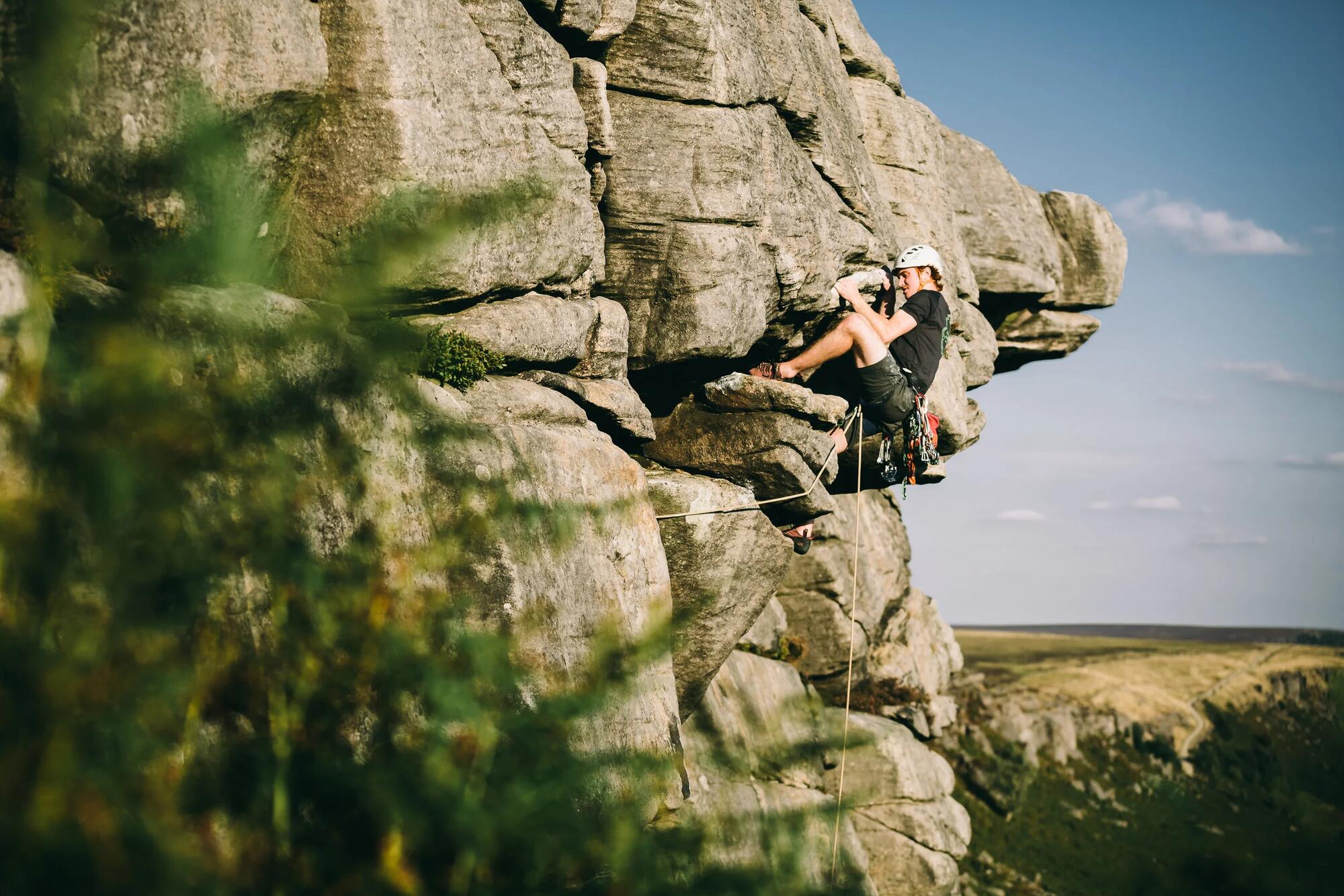

A coach demonstrates a movement. You understand the explanation. You can see what you are supposed to do.
Then you try it on a difficult route and everything arrives at once: balance, timing, grip, the next hold, the possibility of falling. The explanation disappears somewhere between leaving the ground and making the move.
Understanding a skill and being able to use it in a demanding setting are different stages of learning.
Scaled complexity means creating steps between them. The aim is to make practice manageable without losing the connection to the real task.
1Simplify the demand, not the purpose
A useful starting exercise makes the important part of a skill easier to notice and repeat.
For a climber learning to transfer weight onto a foot, that might mean generous handholds, obvious footholds and a suitable low-level practice setting. The task is still about using the foot to support movement. It simply removes some competing demands.
Scaling is not limited to making holds bigger. You can alter how much information is available, how many decisions are required, how movements are linked, or how familiar the environment is.
A footballer might learn a passing pattern without a defender, then with predictable pressure, then with a defender who can choose how to respond.
The thread stays the same. What changes is how much the learner has to manage.
2Create a progression you can explain
Take deliberate foot placement as an example.
At an introductory level, practise on an easy sequence where the next foothold is obvious. At the next level, choose between suitable footholds. Then link the placement to the following move. Later, use the skill on an unfamiliar route where you also need to read what comes next.
Each step adds a reason to adapt. You are not merely repeating the same drill on increasingly difficult holds.
You should be able to answer, "What does this next level ask me to do that the previous one didn't?"
When too many things change at once, it becomes difficult to know why performance has dropped. Adjusting one main demand at a time is a useful way to make the feedback clearer.
Strip it back
One skill, no time pressure, no audience, familiar ground.
Add one demand
Pace, or fatigue, or an unfamiliar hold — one, not three.
Add a decision
Now you have to choose, not just execute.
Put it back together
Full demands — the thing the drill was always for.
Each level should develop something you can name. If you can’t name it, it is decoration.
3Progress through understanding, not lucky completion
Completing a move once is encouraging. It doesn't necessarily mean you can reproduce the skill or explain what helped.
Before making the exercise harder, look for a pattern: repeated appropriate execution, a reasonable understanding of the task, and the ability to recognise and adjust an error.
There is no universal number of repetitions that proves readiness. Four successful attempts can be a game rule, but it is not a scientific threshold.
Equally, one unsuccessful attempt doesn't automatically mean you should return to the beginning. Ask what happened. Was the demand too large, the instruction unclear, or the attempt simply one variable performance?
A progression is there to support learning, not to punish mistakes.
4Keep returning to the whole activity
A drill can become its own little world. You get very good at it, but the original difficulty remains whenever you climb normally.
That is why scaled practice needs regular bridges back to the activity it is meant to support.
After practising foot placement, try an appropriate route with one simple intention: choose a useful foothold and move from it. Notice whether the skill appears without constant instruction. Then vary the setting enough to see whether it is adaptable.
You may need to move back and forth between simpler and more demanding versions. That isn't going backwards. It is using feedback to choose the next useful step.
Keep physical risk separate from learning complexity. Increasing exposure, fatigue or consequences is not automatically a sensible progression.
The aim is not to stay protected from difficulty indefinitely. It is to arrive at greater difficulty with something you can build on.