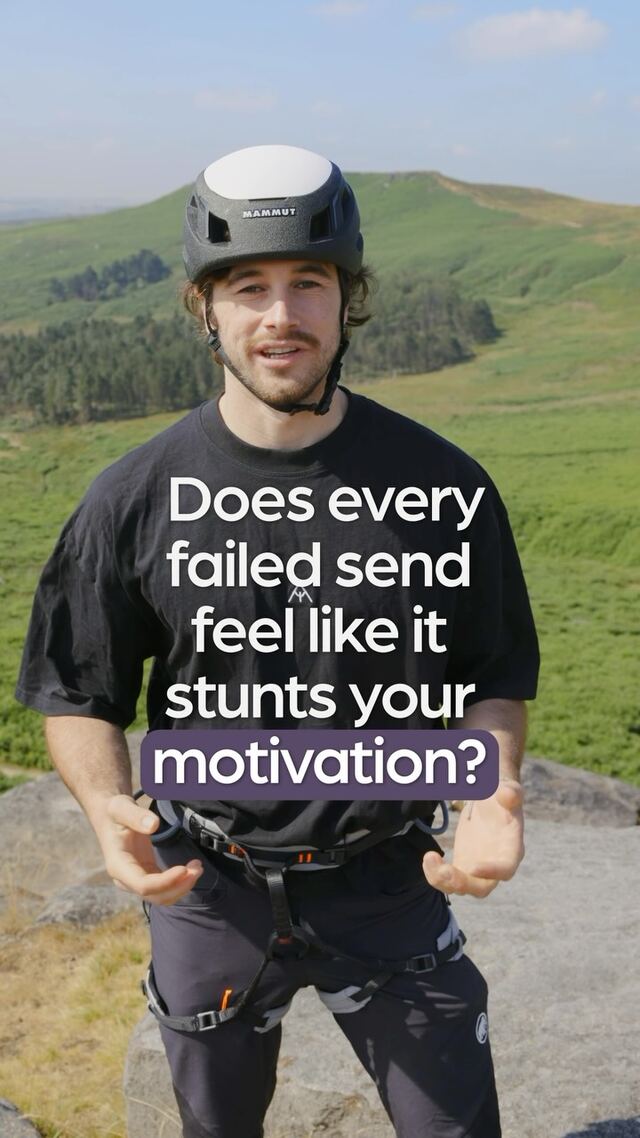
You arrive at the wall with one aim: finish the route you've been trying for weeks. You warm up, pull on, and fall at the same move. By the end of the evening, you feel as though you've achieved nothing.
Except your footwork was more precise. You found a better resting position. You recovered after a difficult attempt instead of letting it derail the session.
Those changes matter. But when success has only one definition, they're easy to miss.
Goal setting isn't just about deciding what you want to achieve. It's about deciding what deserves your attention while you work towards it.
1Give the result its proper place
An outcome goal concerns a result influenced by other people: winning a competition, making a team, finishing ahead of a rival. It can be exciting and meaningful. It also depends on things you cannot fully control.
A performance goal is a personal standard: improving your race time, completing a particular grade, or achieving a measurable strength target. It tells you whether your own performance is developing, although health, conditions and other circumstances still matter.
A process goal concerns what you actually do: follow your pacing plan, practise a particular movement, or use your pre-performance routine. It gives you an action rather than just a destination.
These aren't competing approaches. They work together. The outcome identifies the ambition; performance goals identify useful milestones; process goals shape the work.
2Make progress visible before the result arrives
Imagine a runner preparing for a local race. Finishing in the top ten is the outcome goal. Improving their personal best is a performance goal. Starting at an appropriate pace and following a rehearsed fuelling plan are process goals.
They might run well and finish outside the top ten because the field is stronger than expected. They might achieve the placing despite pacing badly. The finishing position alone doesn't tell the whole story.
The same applies in climbing. Sending a route matters, but it doesn't explain which skills are improving or what needs attention next.
Process goals provide something useful to review between milestones. Research on goal setting in sport supports their value, without suggesting that any goal-setting method guarantees a result.
Ask not only, "Did I achieve it?" but, "What did I do that made it more likely?"
Outcome
Finish in the top ten
Depends on other people. Gives direction, but can’t tell you what to do on Tuesday.
Performance
Beat your personal best
A standard that is yours alone. A useful milestone between here and the ambition.
Process
Hold your pacing plan
Entirely within your control, and reviewable today — whatever the result says.
Process feeds performance, performance feeds the outcome — the control runs the other way.
3Start with the person you want to become
Before choosing the next number, ask what you want your sport to bring into your life.
Adventure? Connection? Curiosity? The satisfaction of learning something difficult?
Now picture yourself a year from today. Not just what you have achieved, but how you approach challenges. Perhaps you are more patient, more consistent, or better able to enjoy a session that doesn't go to plan.
That picture can guide your goals. "Become a more adaptable climber" might lead to practising unfamiliar styles, seeking feedback, and exploring new venues. "Be more confident" becomes useful when you identify what that person actually does.
The point isn't to earn the right to feel good about yourself next year. It's to start behaving in ways that matter to you now.
4Turn intention into an ordinary Tuesday
Choose one meaningful ambition, one useful performance milestone, and one or two process goals for the coming week.
Make the actions observable. "Improve technique" is vague. "Spend ten minutes practising deliberate foot placements after my warm-up on Tuesday" gives you something to do.
Plan around real life. Where will it happen? What equipment or support do you need? What will you do when work runs late? A shorter session may be more useful than abandoning the plan because the ideal version is unavailable.
Then review. Keep what helps, change what doesn't, and allow goals to evolve as circumstances change.
Process focus doesn't mean the result no longer matters. It means you stop asking the result to do the job of a training plan.