Naming what the team already does — and turning it on themselves
Overview
An experienced rescue team already knows how to steady a frightened casualty. They do it on most callouts, usually without naming it, and often without noticing they have done it at all.
That was the starting point for our evening with Edale Mountain Rescue Team. The session covered two linked subjects: supporting casualties whose emotions have run ahead of them, and building resilience to trauma among the volunteers doing the rescuing.
With a team this practised, the job is rarely to hand over new techniques. It is to explain why the things they already reach for work, so those things can be chosen deliberately rather than stumbled upon — and then to ask why the same care so rarely gets pointed back at the team.
“Reinforces the things that we already do well as a team for our casualties but highlights the need to look after ourselves and our colleagues.”
— Ian Stanyon, Training Officer
Organisation
Edale Mountain Rescue Team
Sector
Search & RescueVoluntary
Intervention
Workshop on supporting distressed casualties, understanding responses to trauma, and building individual and team resilience
1. The Foundation
Why a frightened person cannot hear you
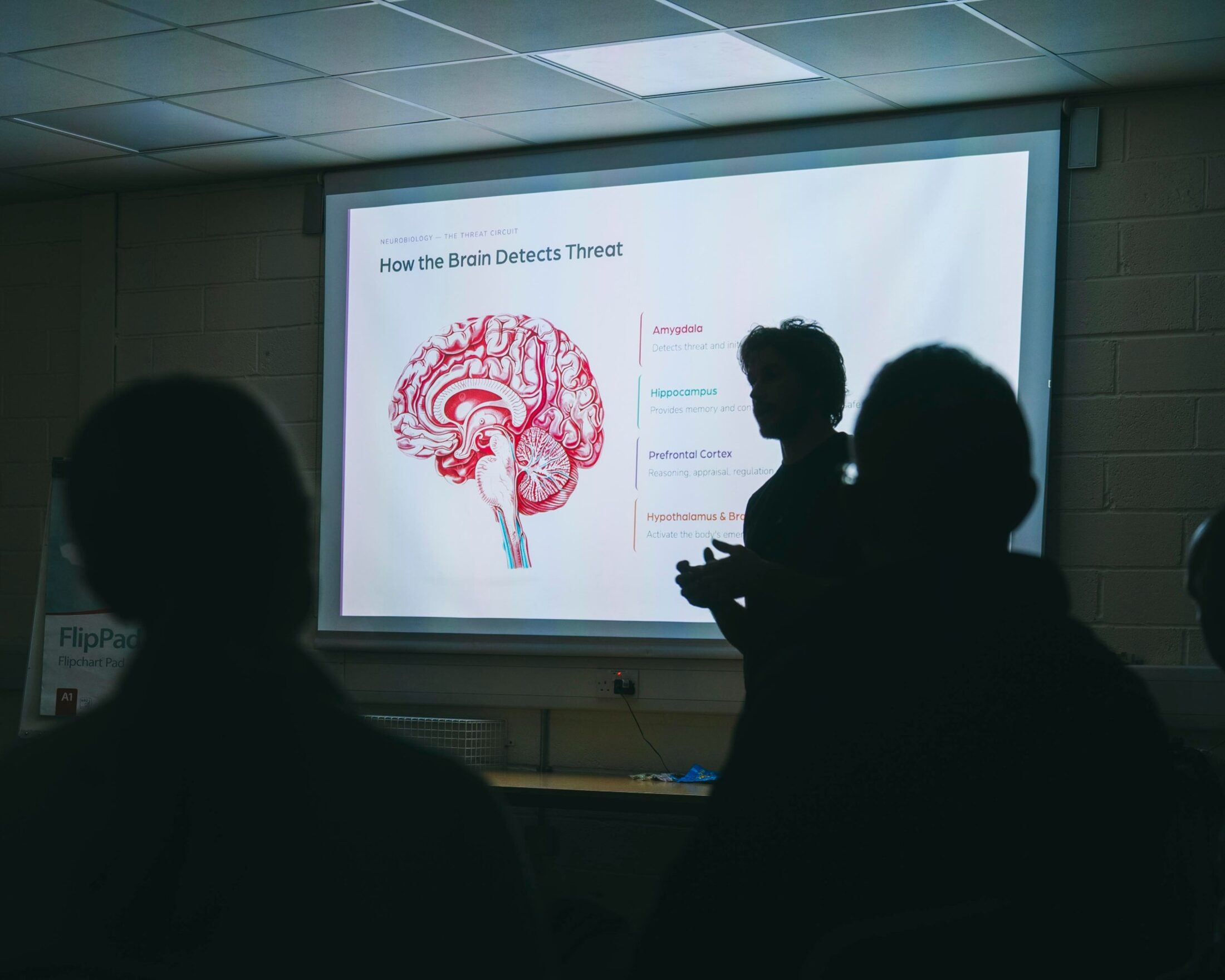
We started underneath the behaviour, with what fear is actually doing. The amygdala flags a threat and the body is committed before any of it reaches conscious thought. The hippocampus supplies context. The prefrontal cortex — reasoning, judgement, weighing options — is the slowest part of the system and the first to lose ground when the alarm is loud.
That matters on a hillside for a very practical reason. Clear, calmly delivered instructions are aimed at the part of the brain that has least capacity at that moment. Repeating them louder rarely helps. Lowering the threat first usually does.
From there we moved to the cognitive model: the situation, the meaning a person attaches to it, and the emotional and behavioural response that follows. An exercise asked the team to take a recent callout and work through four questions — what happened, what the casualty might have believed it meant, how their emotions showed up, and what happened next.
Two people can face identical conditions and have entirely different nights, because they are not reacting to the conditions. They are reacting to what they think the conditions mean about whether they are going to be all right. That reframes the casualty who seems to be making things harder, and replaces an unhelpful judgement with a far more useful question.
“What state are they in, and what do they need from us next?”
The threat circuit, and why reasoning is the first thing to go
2. In the Moment
Three zones, and what each one asks of you
The zones of regulation gave the team a shared shorthand for emotional state — not three types of person, but three places the same person moves between across a single callout as pain, cold, fatigue, information and a sense of control all shift. Knowing which zone someone is in tells you what will land and what will bounce off.
Red
Grounding and safety
Past the point where reasoning is available. It can look like panic — but it can just as easily look like someone gone quiet, flat or far away. The silent casualty is not necessarily the one who needs you least.
Slow your own voice down first
Strip out noise and spectators
Bring their attention to something physical and present
Yellow
Clarity and choice
Frightened, but still with you. Here the work is giving some control back, so the casualty is a participant in their own rescue rather than cargo being moved down a hill.
One instruction at a time
Say what is about to happen before it does
Offer real choices, however small
Green
Connection and comfort
Settled — and worth protecting. Keeping someone in this zone is cheaper than retrieving them from the red one, and it is the part most easily dropped once the casualty stops appearing to need anything.
Keep talking to them
Watch for the drift back
Warmth, shelter and pain relief are psychological care too
“A very useful framework for the skills we employ on call-outs.”
— Kat Netherton
3. Everyone At The Scene
The casualty is not the only person there
A walking partner who watched it happen. A parent who cannot get to their child. A passer-by who stopped and now cannot leave. Each of them is having their own version of the incident, and each of them affects the casualty — in both directions.
A frightened friend standing over a stretcher transmits that fear straight to the person on it. The same friend, given a job and a clear piece of information, becomes one of the most effective sources of reassurance on the hill. They know the casualty. You have known them for ten minutes.
So the team looked at useful roles for the people standing around: holding a torch, carrying something, minding a dog, relaying a message. The task is secondary. What it does is convert helplessness into purpose, which is as much for their benefit as for the rescue.
“Really useful to improve how we help casualties, their friends and family, bystanders and team mates deal with difficult situations.”
— Ed Allaway
4. The Rescuers
The part teams are worst at
The second half turned the same attention onto the team. We covered what post-traumatic stress actually looks like — intrusive memories, avoidance, shifts in mood and belief, a nervous system that will not stand down — and why a reminder of an incident can arrive with the full weight of the original.
Avoidance is the part worth understanding, because it works. Not going back to that stretch of path, not talking about that callout, steering round the subject in the vehicle: each one brings relief, which is exactly why the pattern holds. The relief is immediate and the cost is deferred.
We then split the support into three moments, because what helps during a callout is not what helps a fortnight later.
During a callout
Find the next useful step
When the loop starts — “I can’t do this”, “what if I get this wrong” — swap the question for what is the next best step? Hang it on something you already touch, like reaching for the first-aid bag: notice where you are, name the next action, go back to the job.
After a callout
Create opportunities, not pressure
Making room for a conversation and making someone have one are not the same thing, and the second can do harm. People arrive at it on their own timetable. A standing, optional, unremarkable check-in beats a compulsory round-the-room once the job is done.
Before the next one
Build support into ordinary life
For the individual, four pillars worth keeping in repair: work and roles, relationships, things done purely for enjoyment, and personal growth. For the team, making support so routine that using it says nothing about you.
“Be your own calmest team member.”
An exercise asked people to think of a conversation in which they had felt genuinely heard, and work out what the other person had actually done. Then the reverse: what was missing when a conversation had not helped. The answers assembled the thing themselves — not judging, reflecting back what you have heard, showing you understand, and sitting with it instead of reaching for a fix.
That last one is the hardest for people whose entire training is to solve the problem in front of them. It is also the one that most often makes the difference.
One boundary ran through all of it: a supportive conversation between team mates is not therapy, and it is not meant to be. Distress that persists needs professional support, and knowing where that line sits protects the person listening as much as the person talking.
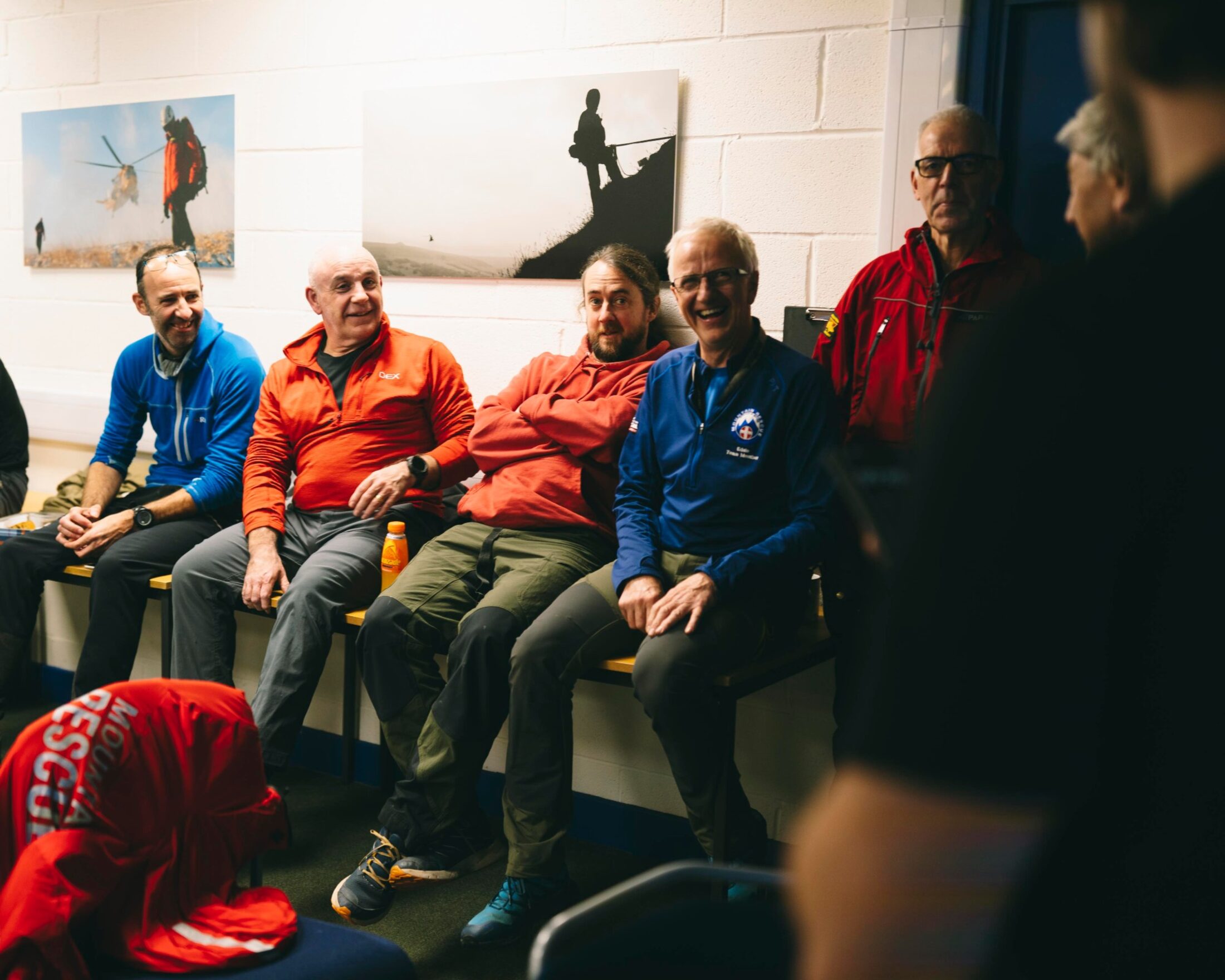
The people who turn out at two in the morning, and who also need looking after
5. The Approach
Putting language to experience the team already had
Every section of the evening came back to the room: a callout where someone had gone quiet, a bystander who had been handed something to do, a conversation that had helped or had not. The team supplied the examples. The psychology supplied the reason they worked.
Nothing here asks an already stretched volunteer team to do more on a callout. It asks them to recognise what they are doing, so it can be repeated on purpose, taught to a new member, and — the part that gets left out — offered to each other.
“Useful and necessary.”
— Tomo Thompson
The Message
Give yourselves what you already give casualties
Resilience is not being unaffected by difficult things. It is having the tools, the relationships and the setting that carry you through them.
Edale are already good at this. They do it for casualties on dark hillsides several times a month. The work from here is noticing that the people beside them in the vehicle on the way home have a claim on the same attention.
Bring This To Your Team
Support that fits the realities of the work
To discuss a session on supporting distressed casualties, understanding responses to trauma, and building individual and team resilience, get in touch.
 Edale Mountain Rescue Team