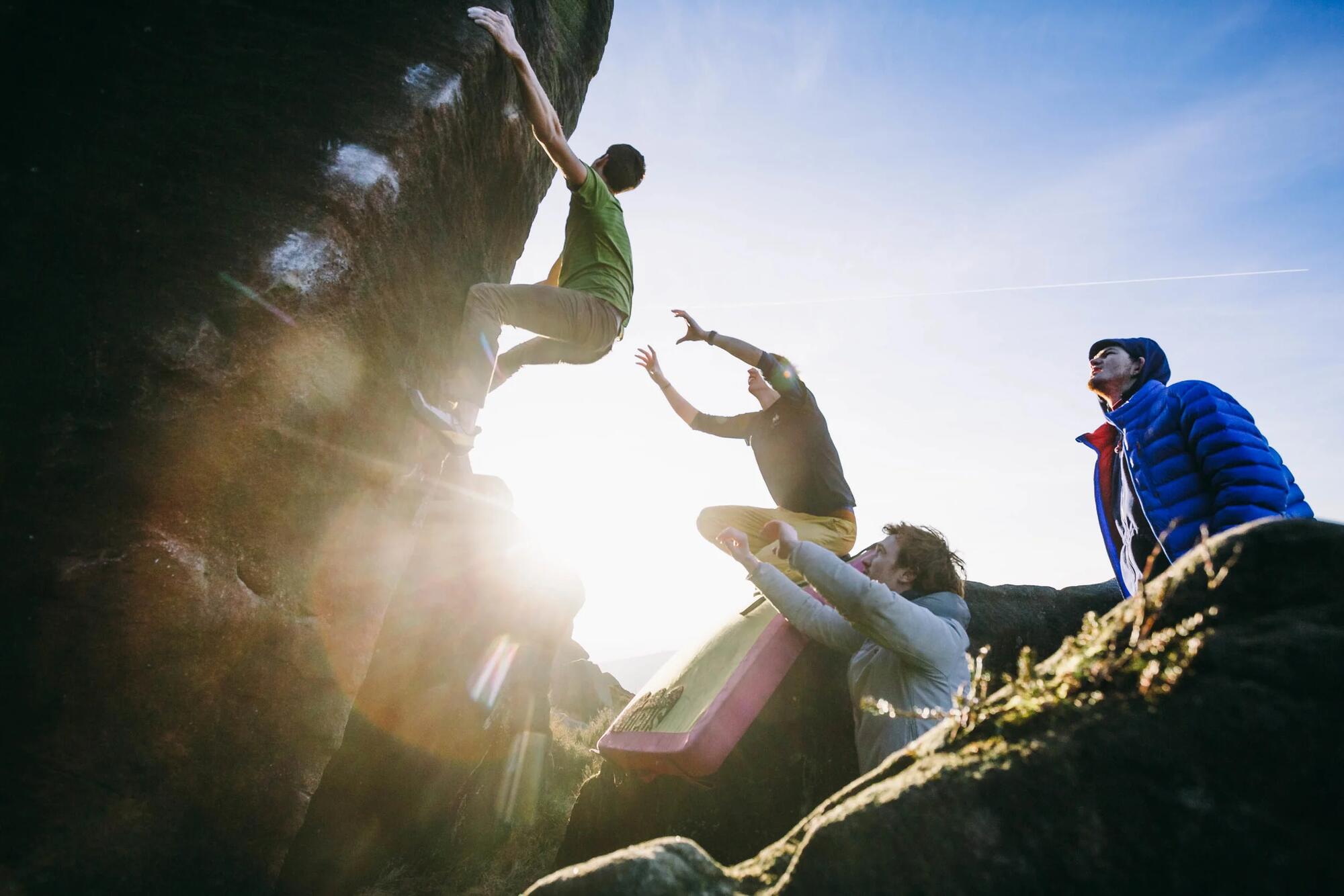

An injury stops you climbing. At first, the problem seems obvious: you can't do your sport.
Then the other losses become clearer. You miss your friends. Your evenings feel empty. The thing that gave you progress, confidence and a sense of who you are has disappeared all at once.
One setback has affected far more than one activity.
This is why resilience isn't simply a matter of being tougher. It also involves looking at how your life is organised, and how much of your identity rests on any one part of it.
1Think support, not invulnerability
Resilience is the capacity to adapt and recover in the face of difficulty. It doesn't mean you are unaffected, recover quickly, or manage without help.
At Expedition Psychology, one practical way to explore it is through four pillars: work, hobbies and leisure, relationships, and personal growth. This is a reflection framework, not a diagnostic test or a complete explanation of resilience.
Imagine that these pillars support your sense of identity. When almost everything rests on one, a problem there can feel like a problem with your entire self.
Keeping other sources of meaning available won't prevent disappointment. It can give you somewhere else to stand while you deal with it.
2Understand your four pillars
Work can provide contribution, structure and purpose. This may include employment, study, caring responsibilities or volunteering. The question is not simply whether you are productive, but what this part of life means to you.
Hobbies and leisure provide enjoyment, play and recovery. There needs to be room for activities that don't have to justify themselves through progress. When your main sport becomes intensely performance-focused, something done purely for pleasure can be particularly valuable.
Relationships offer connection, support and shared experience. Who knows you beyond your results? Who could you talk to without first having to present a successful version of yourself?
Personal growth concerns learning, exploration and development. It might involve a new skill, a creative project, a language, or understanding yourself better. Growth can continue even when a sporting goal has to pause.
The boundaries overlap. A climbing trip may involve leisure, relationships and learning. That's fine. The useful question is whether all those sources of support would disappear if the same activity became unavailable.
Work & roles
Contribution, structure, purpose — paid or not.
Hobbies & leisure
Enjoyment and play that needn’t justify itself through progress.
Relationships
People who know you beyond your results.
Personal growth
Learning, exploring, understanding yourself differently.
3Look for neglect, not perfect balance
You don't need to give every pillar an equal quarter of your time. A major event, a new job or family circumstances may temporarily demand more attention in one area.
Instead, notice what is being repeatedly postponed.
Have all your friendships become training arrangements? Have you stopped doing anything without recording it? Is every conversation about work? Are you treating rest as something you have to earn?
Try a weekly check-in. Rate each pillar out of five according to how well you have nurtured it, rather than how impressive it looks. The number is a conversation starter, not a wellbeing score.
Then choose one small action: arrange a meal with a friend, protect an evening off, return to an interest, or ask for support with a difficult workload.
4Adapt when a pillar is under strain
After injury or a significant setback, it can be tempting to recreate your previous routine as quickly as possible. Sometimes the more useful task is to ask what that routine gave you, and find other ways to meet those needs while you recover.
You may still be able to see climbing friends without training. You may explore a different interest or work on an appropriate rehabilitation plan with a clinician.
None of this requires pretending that the loss doesn't hurt. Self-compassion means allowing that difficulty without turning it into a verdict on your character.
And when distress is persistent or hard to manage, professional support belongs among your resources. Resilience includes knowing when you shouldn't have to carry something alone.